EECE 3300 · Integrated Design Project · IIUM Sem 1 2026/2027

F.L.Y.G.U.A.R.D.
Automated Air Curtain for Kelulut Hives

Fly Larvae Yield-loss Guardian and Automated Repulsion Device — a low-cost, chemical-free horizontal air curtain designed by Group Ibn Al-Khaitam to stop black soldier flies from entering open stingless bee (kelulut) topping boxes during honey harvesting.

RM 89.00
Total Prototype Cost
0.00 mW
Closed-Lid Standby
~6.3 hrs
~25 Harvests / Charge
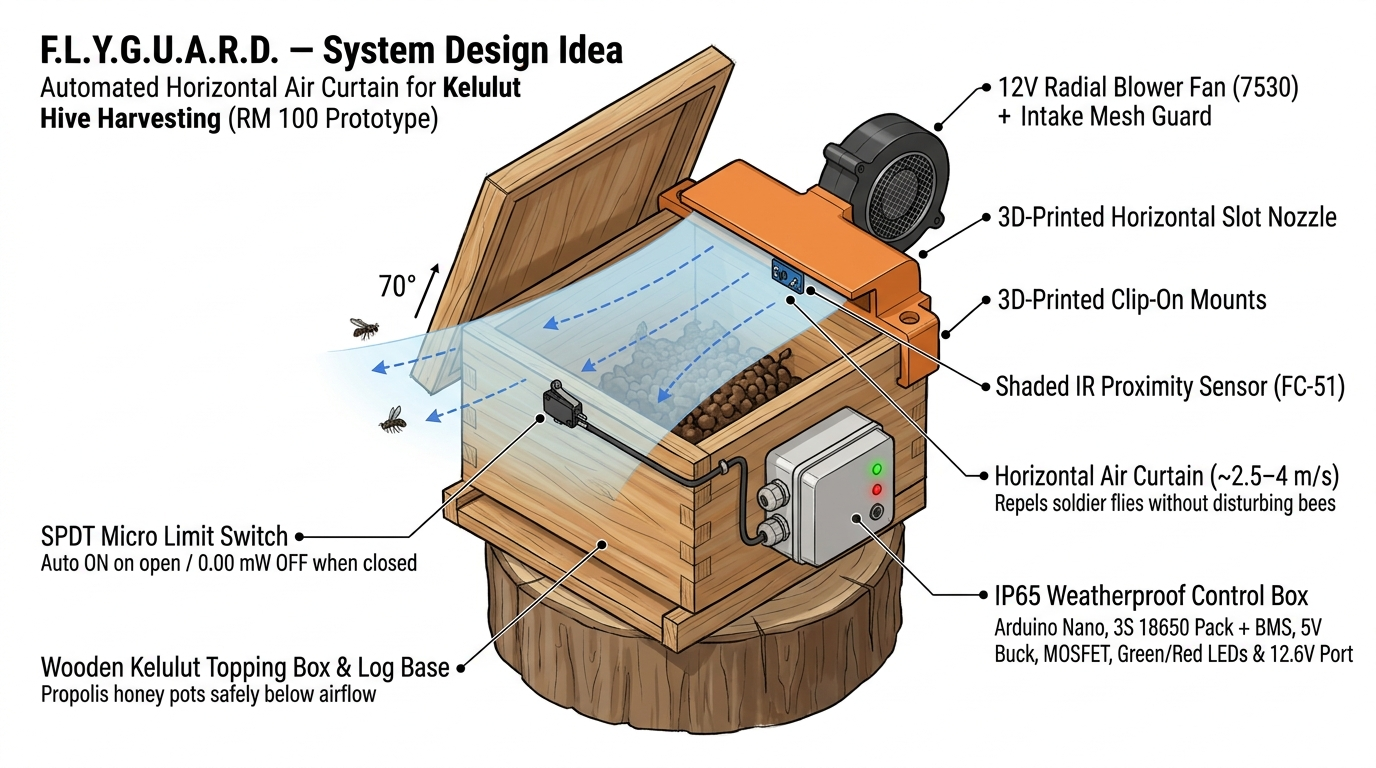
F.L.Y.G.U.A.R.D. System Design Idea
F.L.Y.G.U.A.R.D. clip-on horizontal air curtain mounted on a wooden kelulut topping box.
Group Ibn Al-Khaitam

Our Project Team

Electrical & Computer Engineering undergraduates at International Islamic University Malaysia (IIUM) collaborating on problem discovery, system architecture, electronics, and prototyping for EECE 3300.

Muhammad Hadhari
Muhammad Hadhari bin Mohammad Zulkhairi
Team Leader
2315263
Project coordination, problem statement, literature review, design specifications, and timeline management.
Mohamed Azhan
Mohamed Azhan
User Research & Mechanical
2210813
Farmer interviews, target user profiling, CAD design sketch, and 3D-printed slot nozzle development.
Muhammad Syamil
Muhammad Syamil
System Architecture & Analysis
2218331
Benchmarking, system block diagram, battery/power calculations, and firmware logic flowchart.
Muhammad Nabil
Muhammad Nabil bin Ibrahim
Electronics & Prototyping
2217697
Circuit schematic, breadboard wiring, MOSFET fan driver, Bill of Process, and RM 100 budget control.
Nida
Nida
Sustainability & Requirements
IIUM ECE
Maqasid Shariah & SDG alignment, MoSCoW prioritization, validation criteria, and web documentation.
Section 1 · Tab 1

Problem Identification, Maqasid Shariah & SDGs

1.1 Problem Statement & Supporting Evidence

Problem Statement

During honey harvesting, stingless bee (kelulut) farmers must lift the wooden lid of the topping box, exposing fresh propolis honey pots to the open air. The strong odour of exposed and slightly fermenting honey rapidly attracts black soldier flies (Hermetia illucens and Hermetia fenestrata) to land inside the hive and lay eggs. Once hatched, the larvae feed on honey stores and nest structures, turning the honey sour and causing severe yield and income loss for smallholder farmers.

Industry Focus: Smallholder Agri-Tech / Malaysian Stingless Bee Apiculture (0.5–1 acre farms with 1 to 50 scattered log hives).

Proposed Solution Strategy

Develop F.L.Y.G.U.A.R.D., a clip-on, battery-powered horizontal air curtain that activates automatically the moment a hive lid is opened. By projecting a steady horizontal airflow sheet (~2.5–4 m/s) across the top rim—with an IR-triggered boost when movement approaches—pest flies are physically prevented from landing without using chemicals, without disturbing the bees inside, and without interfering with the farmer's hands during harvesting.

Evidence 1: Hashim et al. (2017)

Documented mass infestations of black soldier fly (Hermetia illucens) larvae in Malaysian Geniotrigona thoracica and Heterotrigona itama kelulut colonies—destroying propolis honey pots, spoiling honey stores, and wiping out 250 colonies within a single week.

Ref: Hashim, N. A. et al. (2017). Journal of Biodiversity and Environmental Sciences (JBES), 11(2), 9–15.

Evidence 2: Ivorra et al. (2020)

Identified two Hermetia soldier fly species colonizing spoiled Geniotrigona thoracica hives in Malaysia, attracted specifically by fermenting honey odours. The authors emphasized preventive hive hygiene and limiting pest access during inspection and harvesting.

Ref: Ivorra, T. et al. (2020). Insects, 11(11), 737. https://doi.org/10.3390/insects11110737

1.2 Target User, Field Interviews & User Needs

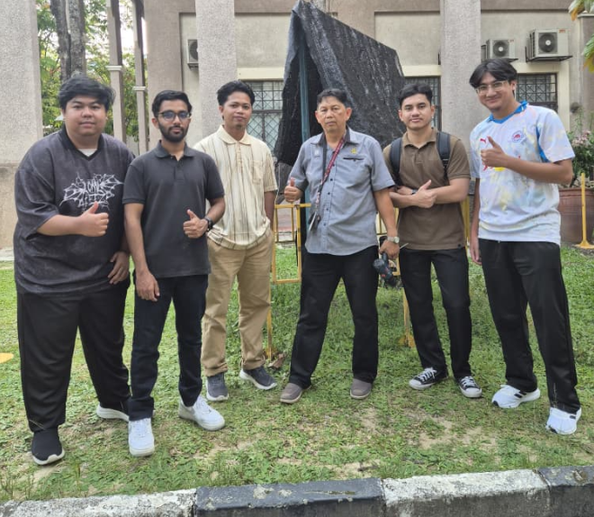
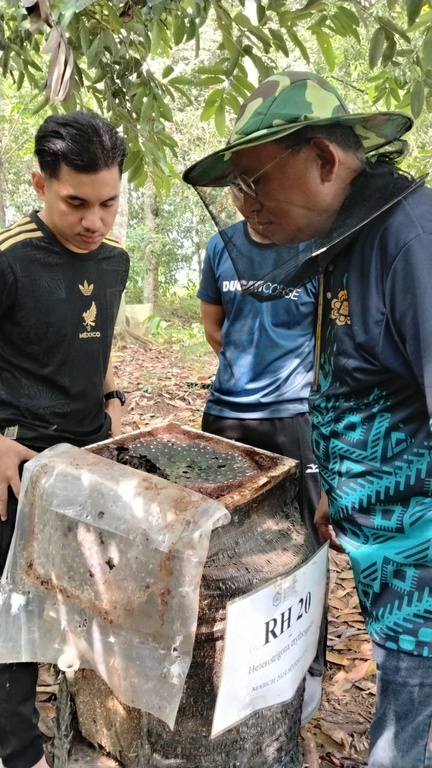
Our team conducted field interviews with local Malaysian kelulut practitioners, Br. Suhairi and Br. Yusni, to observe real wooden topping-box harvesting workflows and verify the recurring pain points caused by fly oviposition.

Team interview with Br. Suhairi
Group interview session with Br. Suhairi
Br. Suhairi
Br. Suhairi (Target User)
Br. Yusni
Br. Yusni (Kelulut Beekeeper)
Inspecting kelulut topping box
On-site inspection of open kelulut topping box

1. Fast Intrusion Prevention

Automatically activate the air barrier as soon as the hive lid opens and boost airflow rapidly when approaching flies or movement enter the rim zone.

2. Safe & Chemical-Free Hygiene

Block flies physically without pesticides or sticky traps that contaminate honey, while guarding fan blades so neither bees nor fingers are harmed.

3. Practical & Low-Maintenance

Work offline in rural orchards without Wi-Fi, consume negligible standby power when closed, and allow hands-free harvesting without dismantling the device.

1.3 Benchmarking & Unmet Needs

User Need / Feature Vinegar / Bait Trap Manual Netting / Mesh F.L.Y.G.U.A.R.D. (Proposed)
Fly & Larvae Infestation Prevention ✓ Partial (lures flies nearby) ✓ Blocks only while covered ✓ Active air curtain during open harvesting
Safe & Hygienic Hive Design ✗ Spills / odour near honey ✓ Chemical-free ✓ 100% chemical-free + intake mesh guard
Ease of Operation & Harvesting ✓ Passive ✗ Must remove mesh to harvest ✓ Clip-on, completely hands-free
Power Saving (Long Standby) ✓ No power ✓ No power ✓ 0.00 mW hardware lid cut-off
Automatic Intrusion Response ✗ None ✗ None ✓ Auto lid trigger + IR proximity boost

1.4 Maqasid Shariah & Sustainable Development Goals (SDGs)

Maqasid Shariah Alignment

  • Hifz al-Mal (Preservation of Wealth): Protects smallholder kelulut farmers from sudden colony wipeouts and sour honey spoilage, safeguarding their family livelihood at an affordable prototype cost (< RM 100).
  • Hifz al-Nafs (Preservation of Life & Health): Eliminates chemical insecticides around edible honey, ensuring halalan toyyiban honey quality while keeping stingless bee colonies healthy and unharmed.

Sustainable Development Goals

SDG 8 · Decent Work & Economic Growth

Strengthens rural smallholder productivity by reducing weekly manual maggot-cleaning labour and preventing catastrophic honey yield losses.

SDG 12 · Responsible Consumption & Production

Reduces post-harvest food waste (spoiled honey) and replaces disposable chemical traps with a rechargeable, reusable physical barrier.

Section 2 · Tab 2

Design Requirements & Specifications

2.1 Core Product Features & Functionalities

Auto-Trigger Horizontal Air Curtain

Opening the hive lid releases the SPDT micro limit switch, instantly starting a steady 60% PWM horizontal airflow sheet across the top rim so honey pots below remain calm.

Shaded Rim IR Proximity Boost

A recessed FC-51 IR sensor under the 3D-printed nozzle hood detects approaching movement near the opening and automatically boosts the blower to 100% PWM for 5 seconds.

True 0.00 mW Hardware Standby

Closing the lid presses the limit switch open, physically disconnecting the 3S 18650 battery pack from all electronics so one charge lasts across ~25 harvesting sessions.

Standalone Offline Reliability

Requires zero Wi-Fi or smartphone setup in rural farms—two clear external LEDs (Green = Active, Red = Low Battery ≤ 20%) and a 12.6V charge port keep operation effortless.

2.2 Design Specification Table (MoSCoW) & Justification

User Needs Design Attributes Design Characteristics Engineering Target
Must Have Specifications
Fast Intrusion Detection & Fly Prevention Response time & airflow repulsion Time from lid open / IR trigger to airflow activation; horizontal jet velocity across rim Response time ≤ 1.0 s; Horizontal airflow 2.5–4.0 m/s; Prevention rate ≥ 90%
Protect Bees & Honey Quality Bee safety & hygiene Horizontal airflow angle above honey pots; physical fan blade guard; chemical-free Zero downward blast into pots; Intake mesh ≤ 2 mm; 0% chemical usage
Power Saving Standby power & active runtime Hardware power cut-off when lid is closed; rechargeable 3S 18650 capacity Standby ≤ 0.50 mW (0.00 mW); Active runtime ≥ 4 hrs (~6.3 hrs)
Affordable University Prototype Manufacturing & BOM cost Off-the-shelf Arduino & 18650 components + 3D-printed PLA nozzle Total prototype cost ≤ RM 100.00 (achieved: RM 89.00)
Should Have Specifications
System Status & Low Battery Alert Visual indication & voltage monitoring External Green/Red LEDs + resistor divider monitoring 3S pack voltage via ADC 2 LED indicators; Red LED triggers at ≤ 20% (≤ 10.2 V)
Ease of Operation & Weather Resistance Accessibility & enclosure rating Tool-free clip-on mounting; sealed electronics box for outdoor farm humidity Hands-free harvesting without removal; IP65 ABS enclosure
Won't Have (Deferred to Future Work)
Camera Insect Species ID & Mobile App Computer vision & IoT connectivity Excluded from current PoC to stay under RM 100 and support offline rural farms Deferred to post-IDP commercial phase
Section 3 · Tab 3

Engineering Design & Design Analysis

3.1 System Block Diagram, Circuit Schematic & Breadboard Layout

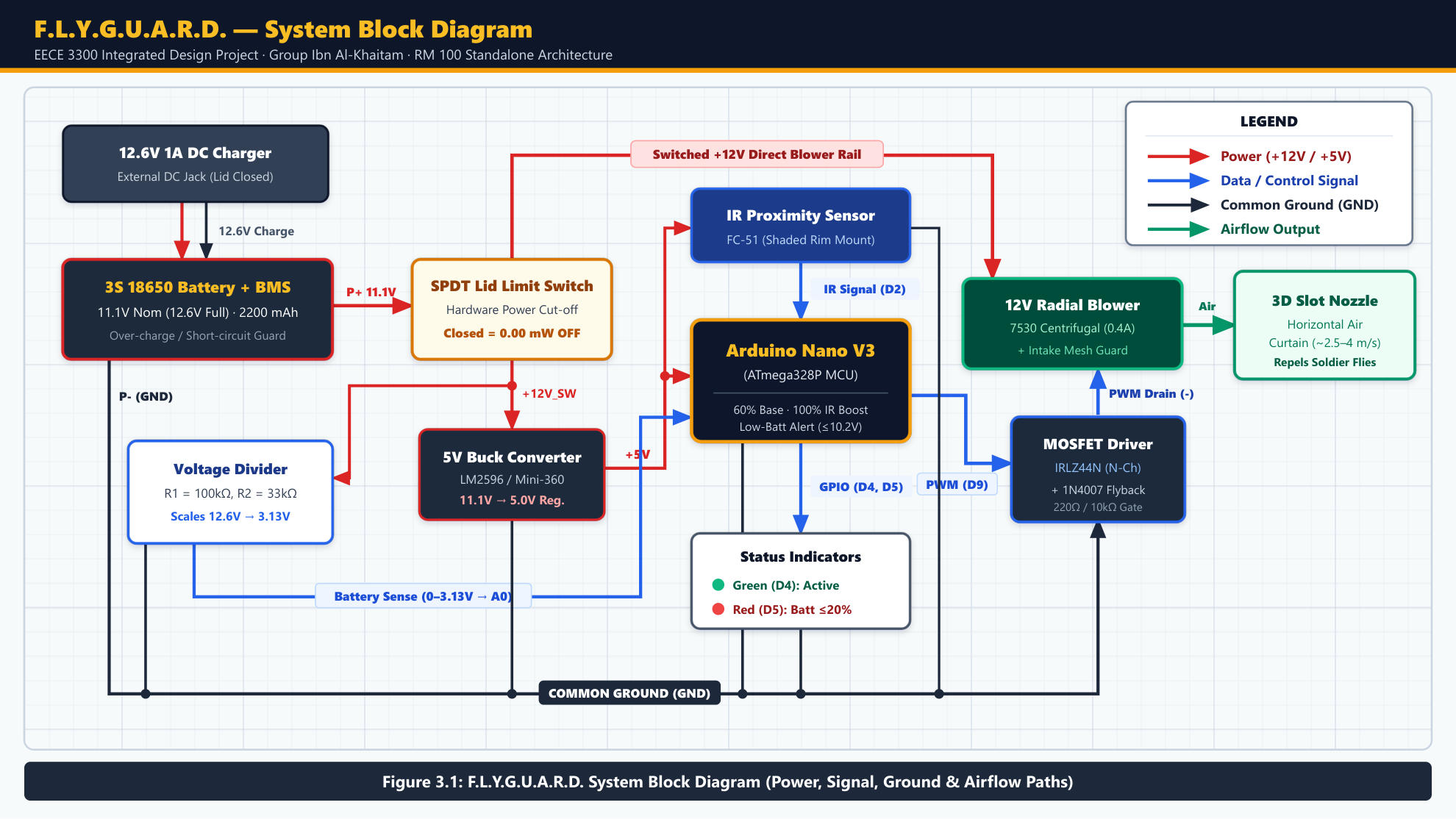
Figure 3.1 System Block Diagram
Figure 3.1: System Block Diagram illustrating Power (+12V/+5V), Data/Control Signals, Common Ground, and Airflow paths.
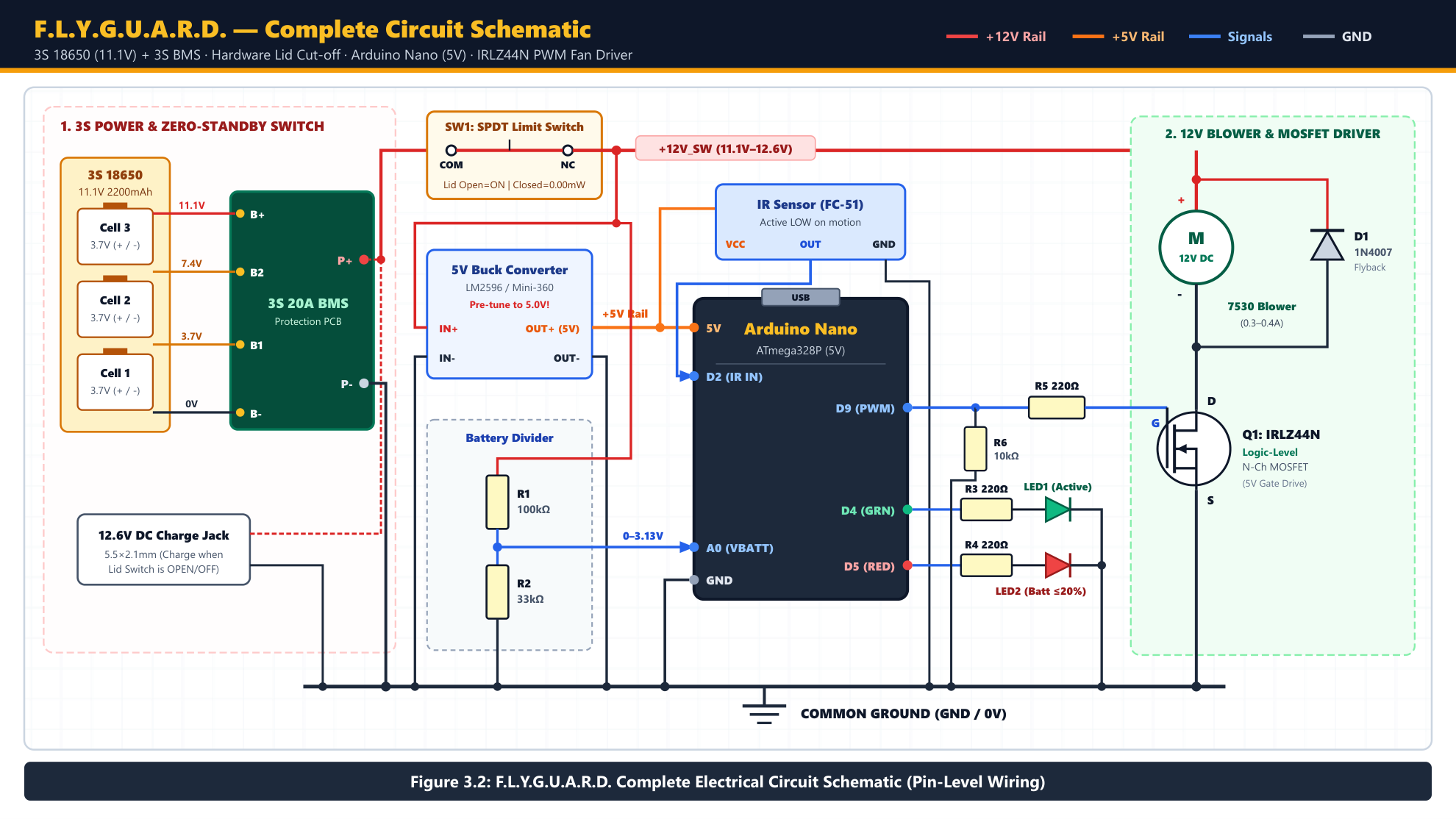
Figure 3.2a Electrical Circuit Schematic
Figure 3.2a: Pin-level electrical circuit schematic (3S BMS, SPDT cut-off, Buck, Divider, IRLZ44N MOSFET & 1N4007 flyback).
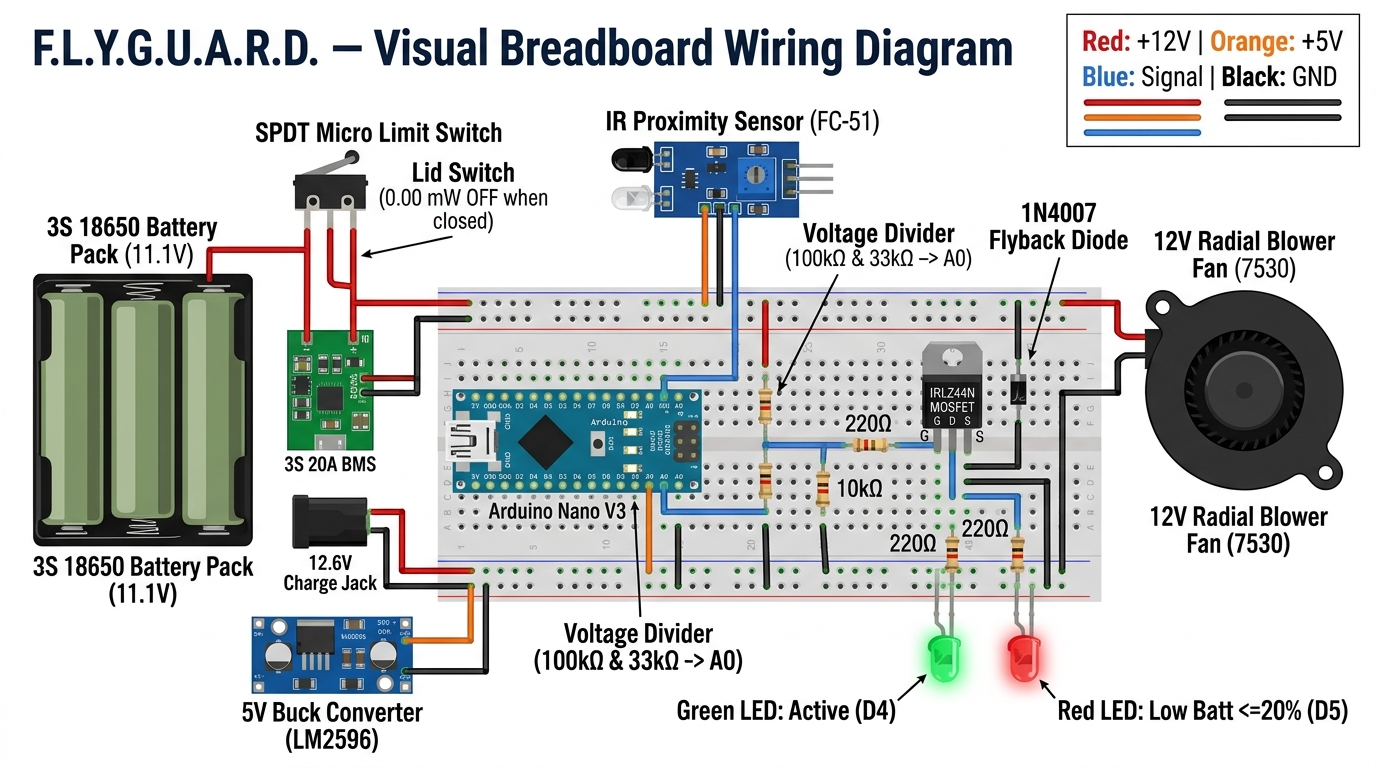
Figure 3.2b Visual Breadboard Wiring Diagram
Figure 3.2b: Visual breadboard wiring layout showing component placement and color-coded jumper connections.

3.2 Bill of Process (BoP) & Engineering Drawing

Part # Enablers Manufacturing Process Attach to Part # Cost (RM)
1Wooden Topping Box & Log BaseBorrow (Farmer)—0.00
2Air-Curtain Slot Nozzle (Horizontal)Custom (3D Print)15.00
312V Radial Blower Fan (7530) + MeshPurchase213.00
4Shaded IR Proximity Sensor (FC-51)Purchase23.00
5SPDT Micro Limit Switch (5A+)Purchase12.00
6Weatherproof ABS Control Box (IP65)Purchase18.50
7Arduino Nano V3 (ATmega328P)Purchase612.00
8Firmware (Curtain, Boost, Batt Check)To Code70.00
9IRLZ44N MOSFET + 1N4007 DriverCustom (Solder)63.50
103S 18650 Pack + Holder + 3S BMS + ChargerPurchase629.50
115V Buck Converter (LM2596 / Mini-360)Purchase63.00
12Status LEDs (2×) + Voltage DividerPurchase62.50
13Perfboard, Wires, Test Switch & GuardCustom (Solder)67.00
14Clip-On Rim Mounts & BracketsCustom (3D Print)1 & 2Incl. in #2
TOTAL ESTIMATED PROTOTYPE COST (Under RM 100 Budget) RM 89.00
Engineering Drawing for Bill of Process 3 2 14 4 5 6 1
Engineering Drawing: Numbered assembly showing how Parts 2–14 attach cleanly onto Part 1 (Topping Box).

Assembly Flow (Attach-To Map)

1Hive Box ← 2Nozzle ← 3Blower 4IR Sensor 14Clips
1Hive Box ← 5Lid Switch & 6IP65 Control Box
6IP65 Box ← 7Nano ← 8Code 9–13Power & Driver

3.3 Design Analysis To-Date & Solution Design Flowchart

1. Standby Power Analysis

The SPDT micro limit switch (COM–NC) physically opens the BMS P+ line when the lid rests on it:

I_standby = 0 mA
P_standby = 11.1 V × 0 A
= 0.00 mW (≤ 0.50 mW ✓)

2. Battery Sizing & Runtime

3S 18650 (2200 mAh) drives the 12V blower directly (no boost loss). At 80% base (242 mA) & 20% boost (422 mA):

I_avg = 0.8(242) + 0.2(422) = 278 mA
Usable (80% DoD) = 1760 mAh
Runtime = 1760 / 278 ≈ 6.3 hrs (~25 harvests)

3. Low-Battery ADC Divider

Wired after the lid switch using R1 = 100 kΩ and R2 = 33 kΩ into Arduino A0:

V_A0 = V_batt × (33 / 133)
12.6V (100%) → 3.13 V (Safe)
10.2V (~20%) → 2.53 V (ADC ≤ 518 → Red LED)
START (Lid Opened) Initialize System Green LED (D4) ON Base Curtain: 60% PWM V_batt ≤ 10.2V? (A0 ≤ 518) Yes Red LED (D5) ON Check IR IR Motion? (D2 == LOW) Yes Repulsion Boost 100% PWM (5 s) Then return to 60% No (Hold 60% PWM) Continuous Loop Until Lid Closes → Hardware Cut-Off (0.00 mW OFF)
Figure 3.3: F.L.Y.G.U.A.R.D. Solution Design Flowchart (Arduino Nano Firmware Logic).
Section 4 · Tab 4

Project Gantt Chart (Weeks 1–14)

Phase Task / Activity PIC W1W2W3W4 W5W6W7W8 W9W10W11W12 W13W14
1. Problem Identification Problem statement & literature review Hadhari
Kelulut farmer interviews (Br. Suhairi & Yusni) Azhan, All
Benchmarking, Maqasid Shariah & SDGs Syamil, Nida
2. Design Requirements User needs & MoSCoW prioritization Nida, Nabil
Design specification table & targets Hadhari, Nida
3. Solution Design & Analysis System architecture & block diagram Syamil
Design sketch, circuit & Bill of Process Azhan, Nabil
Design analysis (battery, runtime, divider) Hadhari, Syamil
Mid-semester website draft submission All Members
4. Prototyping & Validation 3D printing nozzle & hardware assembly Azhan, Nabil
Arduino firmware & benchtop validation Syamil, Hadhari
Presentation 2 & field testing on hive All Members
Final video, webpage & Q&A showcase All Members